Choosing a Custom Home Builder in New Braunfels
Choose a custom home builder New Braunfels families trust for clear planning, accountable construction, refined finishes, and a residence built to last.
Eternity Builders · August 28, 2026
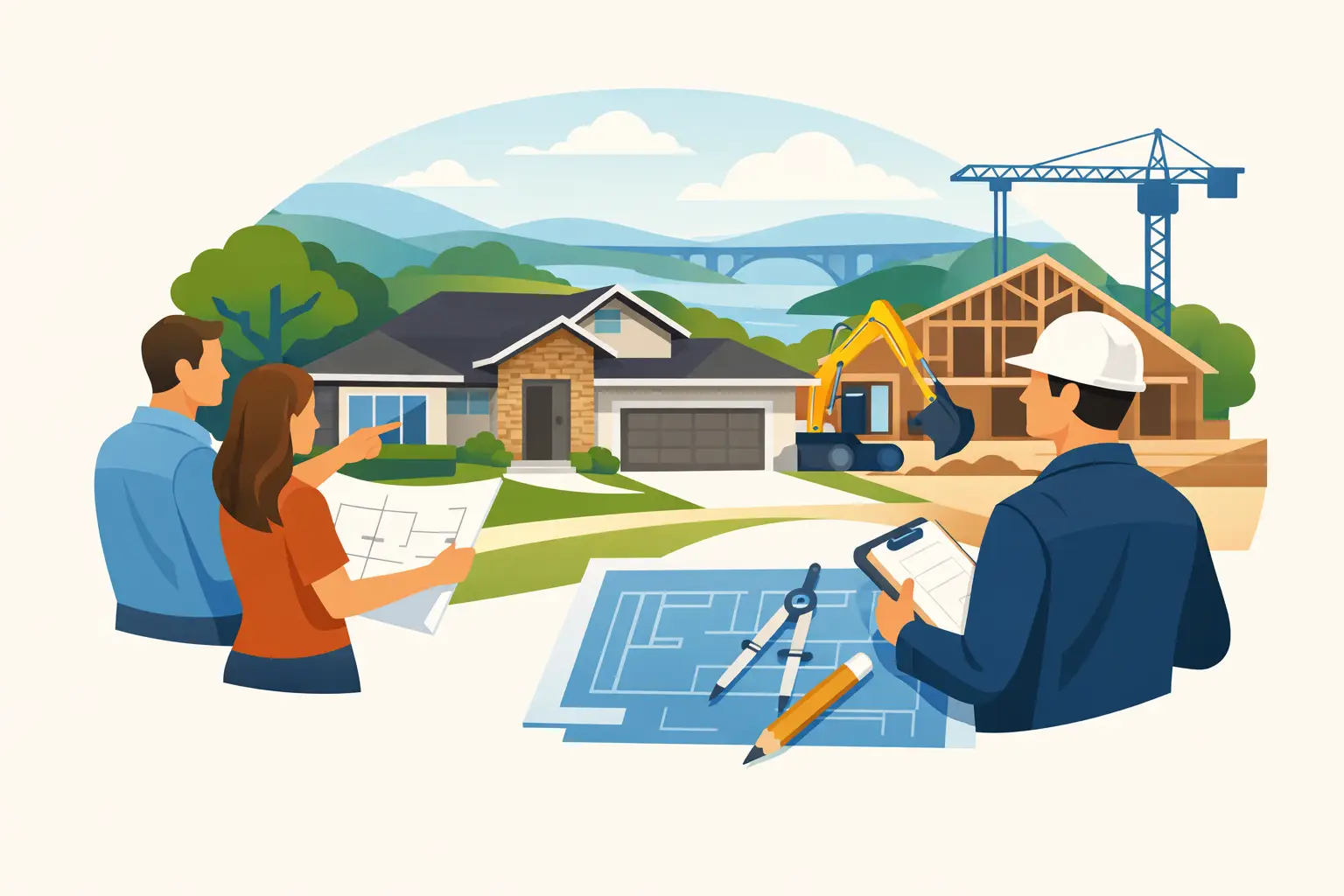
A custom home builder New Braunfels families choose should be prepared to discuss far more than square footage and exterior style. The real work begins with the land: its views, slope, drainage, access, utilities, orientation, and the way your family intends to live there for decades. A lasting residence is not assembled from a collection of selections. It is planned as a complete response to a site, an investment range, and a very personal vision of home.
For families building a primary residence or Hill Country retreat, the stakes are high. The home may host holidays, accommodate aging parents, give children room to return to, and become one of the most significant assets a family owns. That calls for a builder with a disciplined process, visible accountability, and respect for both the details you see and the systems behind the walls.
What a Custom Home Builder in New Braunfels Should Solve
New Braunfels offers a compelling mix of established neighborhoods, private acreage, river-country character, and proximity to San Antonio and Austin. It also presents real building considerations. A beautiful plan can become expensive or compromised when site conditions, drainage paths, utility extensions, restrictive covenants, or rock excavation are addressed too late.
A capable builder begins by identifying those variables before the design is fully committed. This early work does not diminish creativity. It protects it. When the project team understands the site from the outset, architecture can respond intelligently to shade, prevailing views, outdoor living, garage access, service circulation, and the practical cost of construction.
The most valuable early conversations are often direct ones: What investment range feels responsible? Which spaces must be exceptional? Where can complexity be reduced without making the residence feel ordinary? Is the priority a dramatic great room, a serious kitchen, a protected outdoor pavilion, or private guest quarters that work for extended family?
These decisions establish a hierarchy. Without one, a home can accumulate costly features while losing clarity.
Start With the Land, Not the Finish Schedule
Many owners fall in love with stone, fixtures, and cabinetry before the property has been fully evaluated. Those finishes matter, but they should follow a thorough site walk and preliminary feasibility review. On a private estate site, the first decisions shape every one that follows.
Read the site as a building partner
Walk the property at different times of day if possible. Notice where the morning light enters, which views deserve to be framed, and where western exposure will make a terrace difficult to use without deliberate shade. Consider how guests arrive, where deliveries and service vehicles turn, and whether the home can maintain privacy without turning its best rooms away from the landscape.
Topography deserves equal attention. A sloped lot may create an opportunity for a lower-level retreat or a long view from the main living spaces. It may also require retaining, engineered drainage, additional foundation work, and careful coordination of driveways and outdoor elevations. Neither outcome is inherently wrong. The important question is whether the design and budget recognize the condition early.
Confirm the invisible work
Utilities, septic requirements where applicable, soil conditions, water management, and easements are not glamorous subjects. They are among the most consequential. A refined limestone exterior and carefully aligned windows cannot compensate for a project that discovers major civil or structural requirements after pricing is underway.
Ask prospective builders how they investigate these factors, who coordinates the necessary consultants, and how discoveries are communicated. Clear answers at this stage are a strong indicator of how the project will be managed later.
Look for a Preconstruction Process With Real Decisions
Preconstruction is not a ceremonial phase between inspiration and construction. It is where a custom home becomes buildable, financially grounded, and organized enough to move forward without constant rework.
A thoughtful process aligns the architectural concept with structural planning, material choices, site requirements, and the owner’s investment priorities. It also sets a decision calendar. Cabinetry, windows, plumbing fixtures, lighting, tile, appliances, and exterior materials have different lead times and installation dependencies. A builder should help owners make decisions in a sequence that protects the schedule rather than presenting every choice at once.
Transparency matters here. Custom construction will involve variables, particularly on acreage or challenging terrain. No responsible builder can promise that every unknown will disappear. They can, however, establish a clear method for reviewing allowances, changes, lead times, and cost implications before work proceeds.
Be cautious when early pricing is offered without enough information to support it. A broad number may be useful as an initial conversation, but it should not be treated as certainty until the home, site, specifications, and engineering requirements are sufficiently defined. The better question is not simply, “What does it cost per square foot?” It is, “What assumptions support this range, and what has not yet been resolved?”
Evaluate the Builder’s Role During Construction
The construction phase is where a builder’s standards become visible. The home may have a strong architect and an accomplished interior designer, but someone must protect the relationship between drawings, selections, trades, schedule, and field conditions every day.
Coordination is a craft, not an administrative task
Luxury execution often depends on small intersections: a stone joint aligning with an opening, a cabinet reveal landing cleanly at a wall return, trim proportions matching ceiling height, tile layout avoiding narrow cuts, and lighting placement supporting the architecture rather than competing with it. These are not minor details once walls are closed and materials are installed.
Ask who is responsible for site coordination and who has authority to address a condition that does not meet the intended standard. An owner-led builder offers a different level of accountability than a model built around handing coordination to a distant project chain. The distinction is especially meaningful when a residence includes detailed millwork, substantial stonework, large-format tile, custom steel, layered lighting, or resort-caliber outdoor living.
Self-performing general contracting can also improve control. When the builder directly manages the work rather than treating coordination as a separate outsourced function, there is often better continuity between estimating, scheduling, quality review, and client communication. It does not eliminate the need for skilled specialty trades. It clarifies who is responsible for bringing their work together.
Communication should be predictable
A custom home requires many decisions, but owners should not have to chase basic answers. Ask how often you will receive updates, how selections and approvals are documented, and how the team handles a change in scope. The right cadence depends on the project and the owner’s availability, yet the standard should be consistent: timely information, candid explanations, and no surprises hidden behind vague language.
Good communication also includes saying when a requested change carries a consequence. A builder who explains added cost, schedule impact, or design trade-off is protecting the project, not resisting the owner.
Judge Quality Beyond the Photograph
Completed-home images can reveal proportion, material balance, and finish character. They cannot show every aspect of construction quality. During builder conversations, ask to discuss the less visible work: waterproofing approaches, framing standards, mechanical coordination, drainage strategy, window installation, and the inspection process before finishes conceal critical assemblies.
Then look closely at the finished details. Do stone corners feel intentional? Are grout lines balanced? Do cabinet doors, appliance panels, and hardware align? Are transitions between flooring materials clean and restrained? Does the exterior have depth and shadow, or does it read as a collection of applied finishes?
Perfection is not a credible promise in a hand-built residence. Materials vary, trades work in changing conditions, and custom work requires judgment. What matters is whether the builder recognizes the difference between an acceptable condition and an unfinished one, then takes responsibility for resolving the latter.
Choose a Partner for the Long Horizon
The best builder relationship is neither passive nor adversarial. It is a working partnership between owners who make timely, informed decisions and a construction team that brings order, candor, and care to a complex undertaking.
Before committing, consider whether the builder asks intelligent questions about your land, family routines, architectural priorities, and long-term plans. Notice whether the conversation turns quickly to generic packages or stays focused on the particulars that will make your residence yours. A custom home should carry the discipline of a well-managed project while still feeling deeply personal.
Eternity Builders approaches that responsibility as an owner-led commitment, from early site and budget conversations through final punch-list work and move-in readiness. The goal is not simply to deliver a finished address. It is to create a permanent setting where the structure, materials, and daily experience continue to hold up long after the construction equipment is gone.
When you are selecting a builder, choose the team whose process gives you confidence before the first foundation line is marked. That confidence is often the first sign that the home itself will be built with the care it deserves.