Best Luxury Home Lighting Ideas That Feel Built In
The best luxury home lighting ideas pair layered illumination with architecture, materials, and daily rituals for a home that feels enduring over time.
Eternity Builders · October 30, 2026
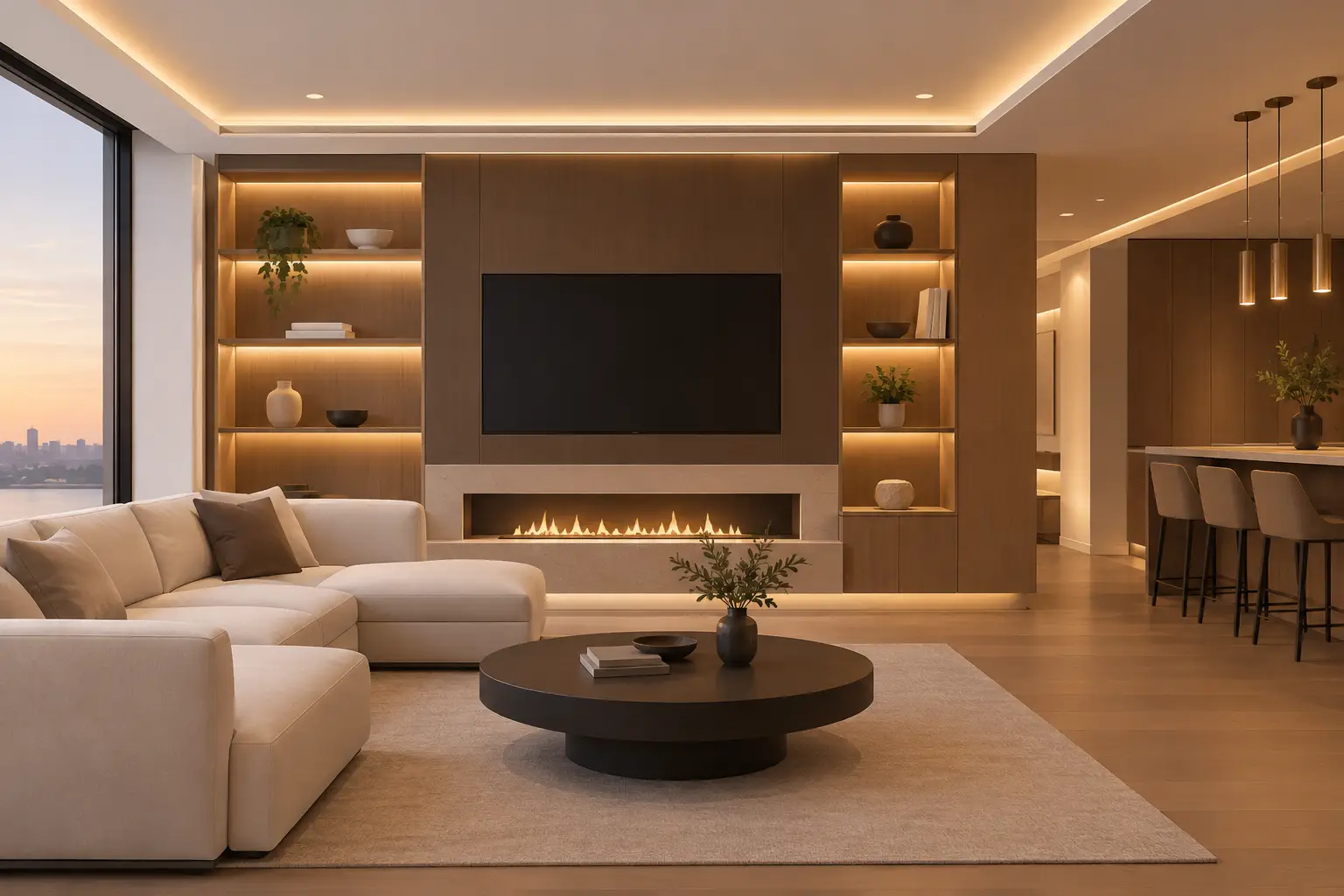
A limestone fireplace can be beautifully proportioned, cabinetry can meet the ceiling with a precise reveal, and wide-plank flooring can carry through an entire residence. Yet if the room is lit by a single bright plane of recessed fixtures, those decisions lose their depth after sunset. The best luxury home lighting ideas treat light as a building material: considered early, coordinated closely, and calibrated to how a family will actually live.
For a custom residence, lighting is not a late-stage decorative purchase. It affects ceiling framing, millwork details, switch locations, stone texture, art placement, window treatments, and the experience of arriving home. The objective is not to make every corner equally bright. It is to establish hierarchy, warmth, and control.
Start With Layers, Not Fixture Shopping
A refined lighting plan gives each room more than one job. Ambient lighting establishes comfortable overall visibility. Task lighting serves reading, cooking, grooming, and preparation. Accent lighting directs attention to architecture, art, a textured wall, or a carefully selected object. Decorative fixtures bring scale and personality, often becoming visual anchors within the composition.
A kitchen offers the clearest example. Recessed lights can provide measured ambient light, while pendants define the island and undercabinet fixtures illuminate the work surface without casting shadows. A statement fixture over a breakfast table can create a softer, more intimate setting after the work of the day is done. None of those layers should compete. They should be independently controlled so the room can shift from weekday breakfast to a full family gathering without feeling overlit.
The same principle applies in quieter spaces. A bedroom should not rely on a chandelier alone, even when that fixture gives the room its character. Bedside reading lights, concealed cove illumination, and discreet directional fixtures make the room useful while preserving its sense of rest. Luxury is often felt in this control: enough light where it is needed, and restraint everywhere else.
Best Luxury Home Lighting Ideas for Architectural Depth
The strongest lighting decisions reveal the materials and volumes that make a house distinct. In a Hill Country residence, that may mean allowing local stone, timber beams, plaster, and deep roof overhangs to read differently from morning to evening. Flat, indiscriminate light tends to erase these qualities. Grazing light and carefully aimed accents can bring them forward.
Let ceiling details carry quiet illumination
A vaulted ceiling does not always need a large central fixture. In some rooms, concealed cove lighting along a beam line or within a perimeter detail gives the ceiling a soft lift without drawing attention to the source. This works particularly well with wood ceilings, where the light can emphasize grain and joinery rather than produce glare on the floor below.
This approach requires early coordination. Cove dimensions, trim profiles, access for drivers, and the placement of HVAC registers all affect whether the detail feels intentional. A narrow slot of light that is uneven or difficult to service will not age well, regardless of how striking it looked on a rendering.
Use wall light to honor texture
Stone fireplaces, hand-troweled plaster, ribbed wood paneling, and specialty tile benefit from directional light. Wall washers provide broad, even coverage. Grazers, placed closer to the surface, create more dramatic shadow and texture. Neither is universally better. A heavily textured stone wall may look exceptional under grazing light, while a smooth plaster finish usually needs a gentler wash to avoid exposing every minor variation.
The fixture location matters as much as the fixture itself. Recessed lights positioned too far from a fireplace can leave the stone visually flat; positioned too close, they may create harsh scallops. Mockups are worthwhile when a feature wall is central to the room. A sample of stone and a temporary light can answer questions that drawings cannot.
Give millwork its own presence
Custom cabinetry deserves more than overhead illumination. Interior cabinet lights make glass-front storage useful and add depth to a dining room or bar. Integrated lighting beneath floating vanities makes a bath feel composed during nighttime use. In libraries and studies, concealed shelf lighting can distinguish the room without turning every bookcase into a display case.
The trade-off is restraint. Lighting every niche, shelf, and toe kick can make an otherwise quiet interior feel theatrical. Select the millwork moments that have genuine architectural importance, then give those moments a purpose.
Design for the View Out, Not Only the View In
At night, expansive glazing becomes reflective unless interior brightness is managed. This is especially relevant in homes oriented toward a long Hill Country view, a pool terrace, or mature oak canopy. If the room behind the glass is fully illuminated, the family may see its own reflection more clearly than the landscape beyond.
A better approach balances lower interior light levels with carefully placed exterior illumination. Path lights can guide movement without creating runway brightness. Downlights in trees can establish a natural canopy. Gentle light along a stone wall, water feature, or terrace edge provides visual depth from inside the home.
Outdoor lighting should also respect darkness. Excessive uplighting flattens a landscape and can make a property feel more exposed than welcoming. The best exterior schemes reveal layers of the site, preserve shadows, and give guests a clear, safe path from arrival to entry.
Put Decorative Fixtures Where They Earn Their Place
A sculptural chandelier can hold a double-height foyer together. A pair of pendants can bring proportion to a generous island. In a dining room, a decorative fixture can set the table before anyone sits down. These are meaningful decisions because they are seen at eye level and remembered.
But a large fixture should be selected in relation to the room, not in isolation. Consider ceiling height, table dimensions, sightlines from adjacent spaces, and the finish palette. An ornate piece may feel misplaced in a home built around quiet stone and clean-lined cabinetry. Conversely, a fixture with too little visual weight can disappear under a vaulted ceiling.
Scale is only part of the equation. Glare is another. Exposed bulbs can look beautiful when dimmed, yet become uncomfortable at normal operating levels. In dining areas and entries, it is worth seeing a fixture illuminated before committing to it. The visual effect of the glass, shade, lamp temperature, and dimming performance should be judged together.
Make Lighting Control Feel Natural
The most sophisticated lighting system is one a household can operate without instruction. That begins with thoughtful keypads, intuitive room groupings, and scenes based on actual routines. “Morning,” “evening,” “entertaining,” and “away” are more useful than a collection of mysterious labels.
Dimming should be planned as a standard expectation in primary living areas, dining rooms, bedrooms, and exterior entertaining spaces. Not every light source dims in the same way, however. Fixture selection, lamps, drivers, and control hardware need to be specified as a compatible system. Otherwise, the result can be flicker, audible buzzing, poor low-end dimming, or a color shift that undermines the finish palette.
Color temperature also deserves discipline. Warm light generally supports natural wood, limestone, brass, and layered textiles, while cooler light can make those materials feel clinical. That does not mean one temperature belongs everywhere. A functional pantry, garage, or utility room may call for clearer visibility than a lounge or primary suite. Consistency within connected spaces matters more than rigid uniformity throughout the house.
Plan Lighting Before the Walls Close
Many of the best lighting effects depend on details concealed inside the home: blocking for decorative fixtures, power within cabinetry, framing for recessed channels, accessible driver locations, and junction boxes positioned to suit furniture layouts. Waiting until finishes are selected can limit the options or force compromises that remain visible for decades.
A disciplined selection process reviews lighting alongside reflected ceiling plans, cabinetry drawings, stone layouts, and furniture plans. It also considers maintenance. Can a homeowner reach the lamp? Is a driver accessible without opening finished millwork? Will a tall stair fixture be serviceable? These practical questions are not separate from luxury. They are what allow a residence to remain composed long after move-in.
Light should make a home more livable before it makes a statement. When the plan respects architecture, materials, nighttime views, and the rhythms of family life, the house feels settled from the moment the sun goes down.