What Owner-Led Building Changes in a Custom Home
See how owner-led building keeps custom-home decisions connected, from early design intent and structural planning to the final details that endure well.
Eternity Builders · August 31, 2026
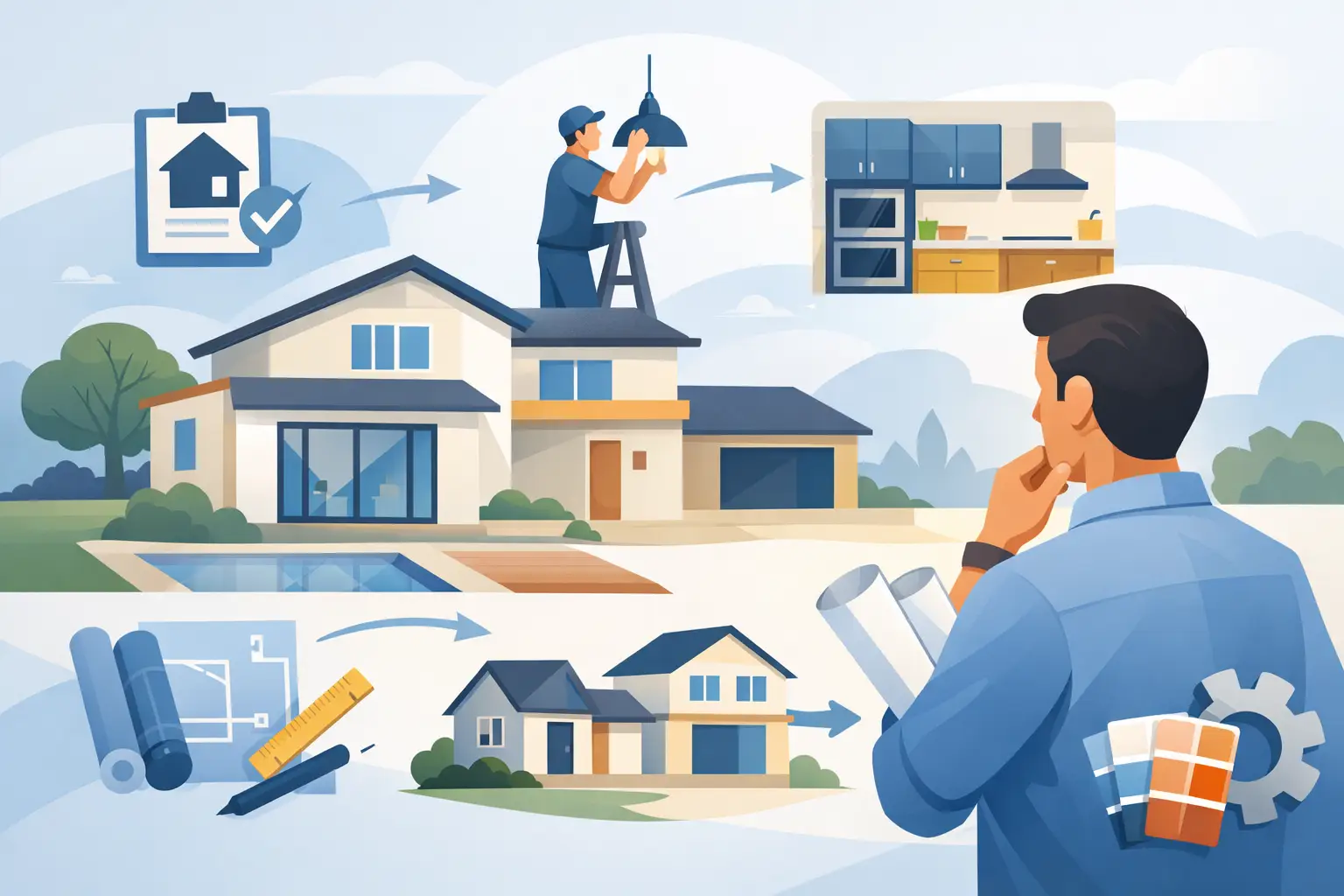
A custom residence can look resolved in a rendering and still lose its character through hundreds of small decisions made after construction begins. The stone may be beautiful, but its coursing can feel arbitrary. A kitchen may have excellent cabinetry, but the reveals, lighting, and adjacent trim may not meet with the same discipline. Owner-led building changes the chain of responsibility behind those moments. It keeps the person accountable for the finished home close enough to recognize when a decision affects the larger whole.
For families creating a forever home, that distinction is not ceremonial. It influences how questions are answered, how details are protected, and how quickly potential problems are addressed before they become expensive or permanent.
Owner-Led Building Is a Working Role, Not a Title
In residential construction, many decisions pass through several layers before reaching the person with final authority. A client may speak with a sales representative, then a project manager, then a superintendent, while architects, designers, suppliers, and trades each manage their own portion of the work. This model can function well when roles are defined and communication is exceptional. It can also create gaps when information changes hands too often.
An owner-led model shortens that distance. The owner remains actively involved in the decisions that shape the home, especially where architectural intent, cost, constructability, and finish quality meet. That does not mean one person performs every task or replaces the expertise of an architect, interior designer, engineer, or skilled trade. It means the person who set the standard remains responsible for how those disciplines come together.
The value is often most visible in matters that seem minor when viewed separately. The height of a window head, the return of a stone corner, the placement of a sconce relative to a mirror, or the transition between flooring materials can each affect the sense of order in a room. Someone with direct ownership of the result is more likely to see these decisions as connected rather than isolated field questions.
The Difference Appears Before Construction Starts
Owner involvement matters most when it begins early enough to influence the right decisions. By the time framing is underway, a home has already inherited many of its opportunities and limitations from site planning, architectural development, structural coordination, and budget review.
On a private Hill Country estate site, the design conversation may include views, approach, grade changes, mature trees, sun exposure, and the relationship between the main residence and outdoor spaces. A strong owner-led process does not reduce these matters to a checklist. It asks how the residence should arrive on the land, what rooms deserve the best orientation, and where a terrace, pool, or covered living area belongs in the daily life of the family.
This same discipline applies to investment decisions. A preliminary budget is not simply a number attached to a plan. It should test whether the design intent is being carried by materials, structural requirements, site conditions, and selections that align with the family's priorities. If an architectural gesture will require more complex steel, specialized stonework, or a different roof strategy, it is better to understand that while the design can still respond thoughtfully.
When the owner of the building company remains engaged in this stage, conversations can become more direct. Instead of protecting a number at all costs or allowing assumptions to carry forward unnoticed, the team can identify where to preserve the elements that make the residence feel lasting and where alternatives may be appropriate.
Clear Decisions Require Clear Ownership
No custom project is free of revisions. Selections evolve, site conditions are revealed, and families occasionally change how they want to live in the home. The issue is not whether questions arise. It is whether the people answering them understand the original intent and have the authority to resolve them responsibly.
A clear ownership structure helps avoid a familiar frustration: receiving an answer that addresses only the immediate task but not the consequence elsewhere. Moving one wall can affect cabinetry, lighting, ceiling framing, mechanical routing, and furniture placement. Changing a tile format may alter the layout at a focal wall or the way a threshold is finished. An owner-led team has reason to follow those implications through.
That does not make the process slower. In many cases, it prevents the slow accumulation of avoidable corrections. Decisions are still documented, trades still need direction, and clients still deserve time to consider meaningful choices. The difference is that the project has a consistent point of judgment when competing considerations need to be weighed.
Quality Control Extends Beyond What Guests See
Luxury is often discussed through visible finishes: natural stone, custom millwork, metalwork, lighting, and richly considered interiors. Those elements matter. They create the experience of the home every day. Yet the quality of a residence also depends on work that will largely disappear behind walls, beneath floors, and above ceilings.
Structural planning, waterproofing details, framing alignment, mechanical coordination, and properly prepared substrate conditions all influence the performance and longevity of the finished work. A tile wall cannot be truly precise if the surface behind it is not prepared for it. A refined ceiling detail can be compromised by late conflicts with ductwork, lighting, or sprinkler components. Exterior stone is only as convincing as its layout, backing, flashing, and transitions.
Owner-led building places visible and concealed work under the same standard. The objective is not to inspect a home only at the end, when many corrections are disruptive. It is to maintain attention at the stages when work can still be evaluated in sequence: foundation, framing, rough-in coordination, enclosure, finish preparation, installation, and final detailing.
For a homeowner, this approach creates a more coherent experience. You are not asked to become the construction manager or chase updates across several contacts. You can remain engaged in the decisions that are yours while trusting that the details between meetings are being managed with the same care.
Direct Access Should Still Be Disciplined
There is a practical misconception that owner involvement means unlimited, informal communication at every hour. That is not the goal. A well-run project needs organized meetings, documented selections, clear approvals, and a reliable schedule. Direct access becomes valuable when it is paired with process.
The strongest owner-led relationships are candid about what is decided, what remains open, and what a particular choice affects. If a selection has a lead-time implication, the conversation should happen early. If a design feature requires more field coordination, that should be explained plainly. If a client is weighing two paths, the guidance should include the trade-off, not just a preference.
This is especially meaningful for clients balancing demanding professional lives with family responsibilities. They do not need more messages. They need the right information at the right time, delivered by people who understand the significance of the decision.
At Eternity Builders, direct founder involvement is supported by self-performed general contracting coordination. This creates a closer line between the original vision, the work in the field, and the final standard of completion. It also allows material and finish decisions to be considered in relation to the entire residence rather than as disconnected purchases.
What Homeowners Should Expect From the Process
An owner-led approach is not a promise that every decision will be effortless or that custom construction will proceed without surprises. Estate sites, specialty materials, and one-of-one architectural details require active problem-solving. The better expectation is that questions will be surfaced early, explained honestly, and resolved by someone personally invested in the outcome.
Homeowners should expect their builder to understand the details that define the residence: the exterior massing, the hierarchy of public and private spaces, the proportion of key rooms, and the transitions that make interiors feel composed. They should also expect a practical grasp of scheduling, procurement, trade sequencing, and the work hidden behind finished surfaces.
Most of all, they should feel that the project has a consistent steward from the first site walk through punch-list completion. A residence intended for children, holidays, long dinners, and future generations deserves more than a handoff between departments. It deserves careful judgment at the moments when plans become permanent.