How to Preserve Mature Trees When Building
Learn how to preserve mature trees during custom home construction with site-sensitive planning, root protection, drainage control, and patient oversight.
Eternity Builders · November 1, 2026
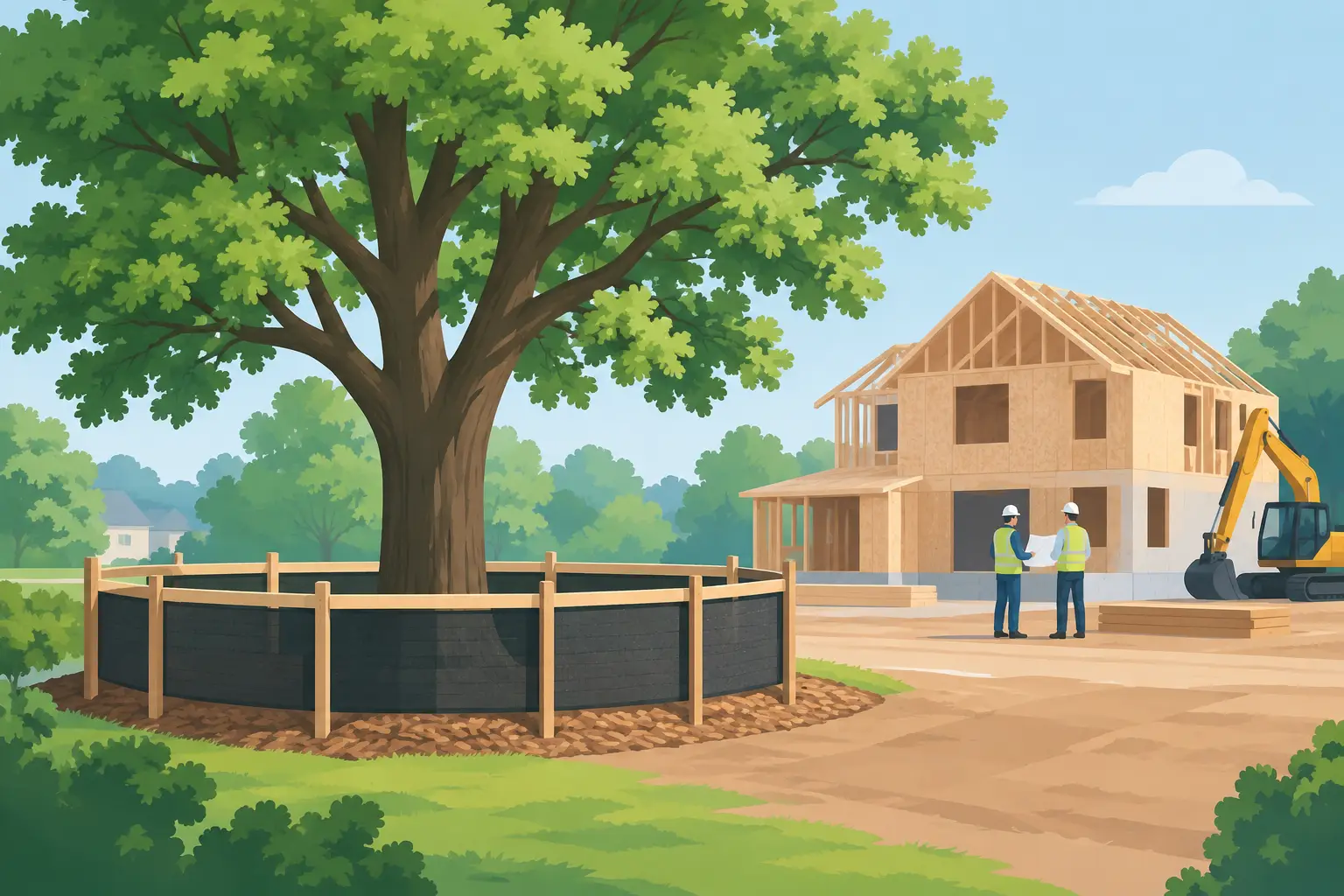
A mature live oak can take generations to become the feature that makes a homesite feel settled. It can also decline quietly for years after construction if its roots were cut, compacted, buried, or left without the water patterns it relied on. Knowing how to preserve mature trees begins before the first building line is drawn, not after equipment arrives.
For an estate home in the Texas Hill Country, trees are rarely background landscaping. They shape arrival, create shade over terraces, frame long views, and give a new residence the sense that it belongs on its land. Protecting them requires a real design decision: the house, drive, utilities, drainage, and outdoor spaces must respond to the tree canopy rather than treating established trees as obstacles to work around later.
How to Preserve Mature Trees Starts With the Site Walk
A productive site walk looks beyond the most prominent trunks. The team should identify significant trees, note their species and apparent condition, study natural grades and runoff patterns, and understand which trees contribute most to the character of the property. A tree that appears healthy from a distance may already be stressed by shallow soils, exposed roots, old storm damage, or poor drainage.
An experienced consulting arborist is particularly valuable early in the process. The arborist can evaluate structural condition, root-zone concerns, pruning needs, and the realistic likelihood that an individual tree will tolerate nearby construction. This is not a guarantee of survival. Living systems carry uncertainty, especially in drought-prone conditions. It is, however, a far better basis for decisions than preserving a tree only because it appears large on a preliminary plan.
Early assessment also prevents a familiar disappointment: designing a residence around a beloved tree, then discovering late in preconstruction that the drive, foundation geometry, utility routing, or finished grade will place too much pressure on its root system. The more settled the design becomes before this work is done, the fewer meaningful options remain.
Design Around the Root Zone, Not Just the Canopy
The visible canopy is only part of the tree. Much of its critical root system lies in the upper layers of soil and can extend well beyond the drip line. Construction impacts therefore reach farther than the trunk. A driveway edge, retaining condition, trench, stockpile, or patio excavation may cause damage even when the tree itself seems comfortably outside the building footprint.
The exact protection area should be determined for each tree with arborist input. It depends on species, size, health, site soils, and the type of work proposed nearby. The key principle is simple: give major trees sufficient room in the plan before the architecture becomes fixed.
That may mean shifting the residence a modest distance, narrowing a drive, changing a motor court configuration, reducing hardscape near a tree, or using a different route for underground services. These choices can affect symmetry, parking, grading, and construction cost. They are still usually less disruptive than trying to solve a root conflict after excavation has begun.
A thoughtful plan can also turn preservation into architecture. A protected oak may define a courtyard, soften a formal approach, or shade an outdoor dining area. The goal is not to force every existing tree into the composition. Some trees are declining, poorly positioned, or unlikely to tolerate construction. The goal is to make deliberate decisions about the trees that will matter to the life of the finished home.
Establish Protection Before Mobilization
Once the trees to be retained are confirmed, their protection zones need to be clearly established before site activity starts. Temporary fencing should be substantial, visible, and placed according to the protection plan, not moved casually to make room for a delivery or a piece of equipment.
Inside that zone, the rules should be equally clear. No equipment traffic. No material storage. No soil piles, washout, debris, or temporary parking. No routine access simply because the area is shaded and convenient. The greatest risk to mature trees is often not one dramatic event, but repeated small intrusions that compact soil and deprive roots of oxygen.
This is where construction management matters. Every trade may have a practical reason to work closer to a tree than planned. The superintendent must understand that a protected area is not unused land. It is an active part of the project that requires control.
If work must occur near a protected tree, the method should be discussed before the work begins. Hand excavation, air excavation, adjusted routing, specialized boring, or a revised detail may be appropriate depending on the conditions. The right response depends on the tree and the scope of work. What should not happen is discovering roots in an open trench and making a rushed decision with a machine already in place.
Protect Soil, Grade, and Water Patterns
Root damage is not limited to cutting roots. Grade changes can be equally consequential. Adding fill over roots may reduce air exchange in the soil. Removing soil can expose and injure roots that developed close to the surface. Either condition can create stress that becomes apparent only after the home is complete.
Drainage deserves the same attention. A mature tree has adapted to a particular relationship with rainfall, slope, and soil moisture. New roofs, paved surfaces, retaining walls, and landscape beds can concentrate runoff in one area or leave another unusually dry. Directing large volumes of water toward a trunk is not a preservation strategy, nor is allowing new construction to shed water away from a tree that once received regular runoff.
A civil and landscape approach should account for these changes as part of the overall grading plan. On Hill Country sites with shallow, rocky soils, water may move quickly across the surface and collect in unexpected ways. Small shifts in hardscape elevation or downspout discharge can matter. The solution may involve carefully located drainage paths, permeable areas, or modified planting zones, but it should be intentional rather than cosmetic.
Irrigation also requires restraint. Newly planted landscaping and established native trees do not necessarily need the same watering schedule. Overwatering around the base of a mature tree can be as problematic as neglect. An arborist and qualified landscape professional can help establish an approach that reflects the species, season, soil, and recent construction stress.
Keep Construction Details From Becoming Tree Damage
Even a well-conceived site plan can fail through ordinary jobsite habits. Concrete washout, paint cleanup, fuel handling, masonry debris, and excess mulch can alter soil chemistry or smother roots. Cutting branches for equipment clearance without direction can leave poor pruning wounds or remove more canopy than a stressed tree can afford.
Pruning should be purposeful and performed by qualified tree professionals. Sometimes selective pruning is necessary for access or for removing deadwood and structural concerns. It should not be used to compensate for a house or drive that was placed too close to the canopy.
Communication is equally practical. The tree-protection plan should be reviewed with the people making daily decisions: excavation crews, concrete teams, framers, masons, landscape contractors, and delivery drivers. A note on a plan set is not enough. The expectation needs to be reinforced as the work changes from clearing to foundation, then from exterior construction to hardscape and landscape installation.
Expect a Longer Horizon for Tree Health
A retained tree can look fine when construction ends and still struggle later. Stress symptoms may include canopy thinning, smaller leaves, dieback, premature leaf drop, fungal growth, or new insect activity. Some of these signs can have unrelated causes, which is why post-construction observation is worth taking seriously.
Plan for arborist follow-up during the first growing seasons after move-in, particularly for trees that experienced nearby work. Corrective care may involve pruning, mulching, watering adjustments, pest management, or further soil evaluation. There are no universal prescriptions, and aggressive intervention is not always beneficial. The better approach is to respond to the specific tree and its conditions.
Preserving mature trees also means accepting that not every tree can or should be saved. A compromised tree near a home, guest suite, drive, or gathering area can create a future safety concern. Removing one tree thoughtfully and protecting a stronger grove may be the more responsible choice for the family and the property.
A home can be built in a matter of months. The shade, scale, and quiet presence of a mature tree cannot be replaced on that schedule. When preservation is treated as part of the architecture and managed through every phase of construction, the finished residence has the chance to feel rooted from the day its doors open.