Designing and Building a Custom Home for Texas Hill Country Land
How Hill Country land shapes the house: topography, rock and excavation, foundation strategy, drainage, orientation and glass, tree preservation, access, utilities on acreage, materials, and outdoor living.
Eternity Builders · July 21, 2026
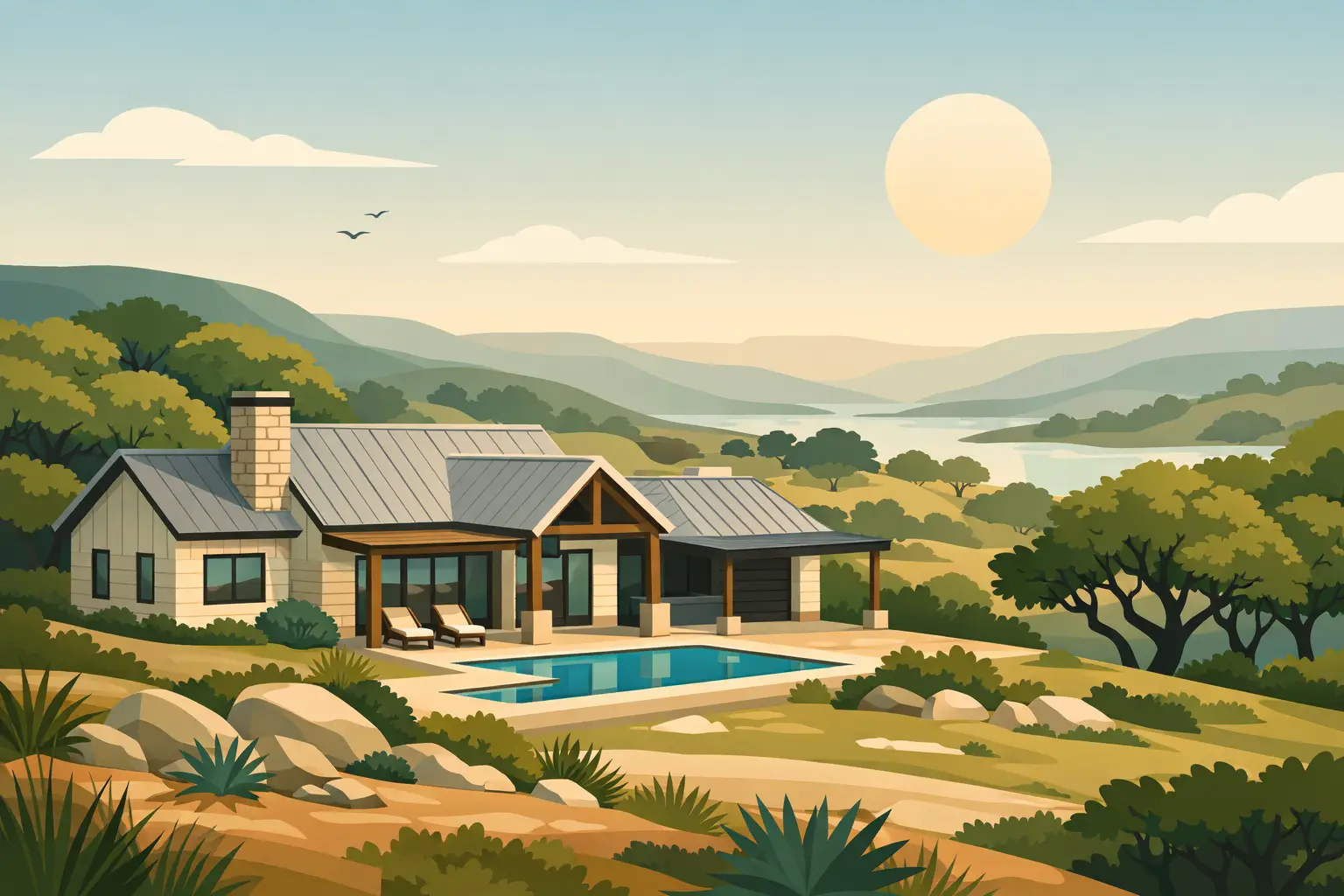
In the Texas Hill Country, the land decides more about a house than the floor plan does. Slope sets the foundation. Rock sets the excavation budget. Water movement sets where the house can sit at all. Orientation sets how the home feels in August. This guide is about that relationship — the site-driven decisions worth resolving before a plan is finished, written for owners who already have a property in mind or in hand.
Start with topography and slope
A topographic survey is the first document worth paying for. It tells you where the natural building pad is, how much fall crosses the house footprint, and what the driveway will have to climb. Modest fall across a footprint can often be absorbed by a stepped slab or a partial drop; more fall usually means retaining, engineered fill, or a design that steps with the grade. None of that is a problem — it is simply a cost and a design decision that should be made on paper rather than discovered at excavation.
Slope also decides where you cannot build economically. Pushing a house twenty feet uphill for a better view can add retaining, drainage, and driveway work that outweighs the view itself. Walk the property with your builder and designer before the footprint is fixed.
Rock and excavation
Limestone at shallow depth is common across much of the region, and it cuts both ways: it generally provides good bearing, and it makes anything requiring digging more expensive. Rock affects foundation work, utility trenching, septic installation where applicable, pool excavation, and any retaining the site needs. Depth varies not only lot to lot but corner to corner on the same lot, which is why a soils or geotechnical report with borings in the actual footprint is worth ordering early.
Ask what the last rock-heavy site cost to prepare. The answer will be specific if the builder has done it.
Foundation strategy
The right foundation is the one an engineer designs for your specific site conditions and your specific structure — not a standard detail applied everywhere. What varies is the soil profile, the depth to competent rock, the amount of cut and fill, and how the structure loads the pad. Get the geotechnical report into the engineer's hands before the plan is final; foundation design and floor-plan geometry inform each other.
Drainage and stormwater
Hill Country rain tends to arrive fast and move fast, and water is the long-term risk to any home built on a slope. The pieces that matter are a coordinated system rather than individual items: site grading away from the structure, swales that carry water around the pad, culverts and low-water crossings on the driveway, roof drainage and gutter discharge routed well away from the foundation, terrace and pool-deck drainage, and adequate separation between finished floor and finished grade.
Resolve these during design with your civil or site consultant. Fixing drainage after the driveway is poured and the landscape is installed is the most expensive version of the same work.
Retaining conditions
Sloped sites frequently need retaining somewhere — to create a level pad, to hold a driveway cut, to make a usable yard, or to build a pool terrace on grade. Retaining walls are structural elements with drainage behind them; height, surcharge, and materials all belong in an engineered detail. They are also highly visible, so decide early whether a wall is finished in native stone as part of the architecture or hidden by grading, because that choice changes the budget.
Orientation, views, and solar exposure
The best view and the hardest sun are often in the same direction. Orientation is the cheapest decision in the entire project and the only one that is genuinely impossible to fix later. Position the long elevation, the primary suite, and the covered outdoor rooms deliberately relative to both the view and afternoon sun, and walk the site at morning, midday, and late afternoon before committing.
Large windows and heat gain
Big glass is why people build here, and it is also the largest single variable in summer comfort. The ways to keep the view without paying for it every August are architectural: deep porches and generous overhangs sized for the sun angle, shaded outdoor rooms in front of the largest openings, careful placement of west-facing glass, and a considered glazing specification with your window supplier. Mechanical design should follow the glass package, not the square footage.
Tree preservation
Mature oaks are effectively irreplaceable, and most are lost to construction traffic, grade changes, and root-zone compaction rather than to intentional clearing. Decide which trees stay before the site plan is drawn, protect their root zones physically with fencing during the build, and route access, staging, and material drops around them. Where a tree sits close to the footprint, adjusting the footprint is usually cheaper than losing the tree.
Driveway placement and site access
On acreage, the driveway is a real line item and a real design element. Length, grade, curve radii, turnarounds, drainage crossings, and the surface material all matter, as does whether it can carry a concrete truck and a crane during construction. Where the driveway meets the road and how it approaches the house also set the arrival sequence — one of the few things that makes a home feel considered before you ever open the door.
Septic and well considerations, where applicable
Some Hill Country properties connect to public water and sewer; many rely on a well and an on-site septic system. Where an on-site system applies, feasibility, system type, and location are determined by site conditions and by the reviewing authority for that property, so the sequence matters: confirm feasibility and the approved location before the house footprint, driveway, pool, and future outbuildings are fixed. The same is true of a well — siting, and the distance from it to the house and to the septic field, affects the site plan. Requirements vary by county and property, so verify the current rules with the authority having jurisdiction rather than assuming what applies.
Utilities on acreage
Electric service may require a long run, and the cost and the routing are worth confirming with the provider early. Many properties use propane rather than natural gas, which means a tank location and a service route. Internet options vary considerably outside of town. And every buried run — power, water, propane, septic line, irrigation — has to coexist with the driveway, the trees you are keeping, and the rock. Getting all of it onto one site plan is what prevents the trenching from cutting through something you cared about.
Wildfire-conscious design considerations
Building in a wooded or brushy setting is a reasonable moment to think about defensible space and ignition-resistant detailing. Common approaches include managing vegetation immediately around the structure, using non-combustible exterior materials such as stone and metal, detailing eaves, soffits, and vents thoughtfully, choosing decking and outdoor materials with fire behavior in mind, and maintaining driveway access adequate for emergency equipment. What is required, if anything, depends on the property and the authority reviewing it — treat these as design considerations to discuss with your designer and local officials, not as a code summary.
Exterior materials suited to Hill Country conditions
Native stone, standing-seam metal, and heavy timber read as belonging here largely because they perform here: thermal mass, water shedding, resistance to hail and sun, and low maintenance over decades. Full-height stone behaves differently from thin applied veneer, and roof selection interacts with both radiant heat and storm exposure. The reasoning is durability first and style second — the same logic we use in luxury new construction that lasts and in our look at finish details that hold up.
Indoor/outdoor living and covered outdoor space
Outdoor living is the reason to build on Hill Country land, so it should be designed as structure rather than added as an amenity. That means covered terraces framed and drained as part of the roof system, ceiling heights and openings that make the transition feel continuous, screening or fans where evening insects and heat are a factor, and gas, water, electrical, and drainage stubbed where the outdoor kitchen and fireplace will actually be. Depth matters more than square footage: a shallow porch on a west elevation is unusable in July. See resort-style outdoor living design for how these spaces get planned.
Pool placement
A pool is a site decision before it is a design decision. Excavation meets the same rock the foundation does, the shell needs access for equipment, and the deck has to drain somewhere that is not the house. Placement also interacts with view lines from the main living spaces, afternoon sun, wind, tree cover and leaf drop, equipment location and noise, and any retaining needed to get a level terrace. Deciding on the pool during design — even if it is built later — lets you rough in the utilities and grade for it once.
Why a stock plan often needs substantial modification
Most stock plans are drawn for flat, rectangular, suburban lots with utilities at the street. Put one on a sloped acreage tract and several things usually have to change: the foundation type, the garage and driveway approach, the roof and porch depths for the actual sun angles, the placement of glass toward the real view, the mechanical and utility routing, and often the geometry of the footprint itself so it sits on the natural pad. A stock plan can be a very useful starting point for program and feel — it is rarely a finished construction document for a specific Hill Country property. Budget for the redesign rather than being surprised by it.
Why site evaluation belongs early in design
Nearly everything above is inexpensive to decide and expensive to change. A survey with topography, a geotechnical report, utility and on-site system feasibility, and a genuine walk of the property at different times of day cost a small fraction of the build and determine most of what the build will cost. Buying a plan first and fitting it to the land second is the most expensive sequence in custom home construction.
If you already own the property, our guide to building a home on private land covers access, utilities, and the permitting sequence in more detail.
Where we build
Eternity Builders works across the region as a Texas Hill Country custom home builder, and site planning is where our involvement starts rather than ends. If you are weighing a specific property, Eternity Builders' Texas Hill Country custom home services page explains how we approach building a custom home in the Texas Hill Country from the first site walk through close-out. We build in Boerne and Kendall County, Fredericksburg, Bandera, and Mico and the Medina Lake area. You can see how site strategy shows up in a finished home in The Ridgeline Estate.